PIMS
PIMS is a project information management platform purpose-built for complex capital delivery. Its organizing principle is simple: the engineering objects of your project — equipment tags, systems, areas, and documents — are the center of the record, not folders or task lists. Every change, every punchlist item, every commissioning verification, and every turnover package connects to the object it belongs to.
Core Capabilities
Each capability in PIMS addresses a specific gap in how capital project information is typically managed — and connects to every other capability through a shared project record.
Formal Change Control PCN & FPIDCN
- What it includes: Project Change Notifications with root cause classification, cost and schedule impact tracking, vendor impact assessment, and system linkage. Field Change Notifications capture construction deviations and link them to affected documents in real time — not reconstructed at closeout. Complete change history on every action.
- Why it matters: Change is inevitable on complex capital projects. What separates well-executed projects from problematic ones is whether changes are formally documented, impact-assessed, and traceable. An undocumented field change to a drawing is not a minor gap — it is a risk to every downstream team that relies on that record.
Action Items & RFI Management
- What it includes: Action item tracking across all project phases with source, type, priority, vendor assignment, discipline, due date, and closure status. RFI workflow with system and discipline tagging, document linkage, response tracking, and resolution documentation — with import capability for EPCM- or CM-originated RFIs.
- Why it matters: Action items and RFIs are where project commitments are made and broken. PIMS ensures every open commitment is visible, assigned, and tracked to closure — with the history intact for post-project review and future project learning.
Engineering Data Management
- What it includes: Equipment and component tracking from classification and tagging through serial numbers, system association, and milestone dates. Configurable datasheets capture design specifications and field verification values. System and area hierarchy provides the organizational backbone for commissioning sequence and turnover planning. Line lists, cable lists, and spatial hierarchies for projects requiring connectivity tracking.
- Why it matters: When your datasheet for a specific tag is complete, verified, and linked to its change record, you know something no Gantt chart can tell you: that piece of equipment is ready for the next phase. Engineering data management shifts visibility from task completion to actual commissioning readiness.
Construction completion report (CCR)
- What it includes: Tag-specific verification records auto-populated from engineering datasheet data already in the system. Field teams verify against pre-populated design values — instrument ranges, calibration data, installation requirements. CCR forms are configurable for project-specific requirements. Completion status is visible at the system and portfolio level.
- Why it matters: Completion verification records are the documentary evidence that equipment was installed and verified correctly. Generating them from engineering data already in PIMS eliminates the most error-prone and time-consuming step in pre-handover preparation — the manual re-entry sprint that typically happens in the final weeks of construction.
Punchlist Management
- What it includes: Punchlist capture with priority classification, trade and contractor assignment, system linkage, room and equipment association, estimated cost, and closure tracking. Dashboard views by priority, by trade, and by system — including a Zero Punch System Tracker showing which systems have cleared all open items and are ready for walkdown sign-off.
- Why it matters: A punchlist managed by spreadsheet tells you how many items are open. PIMS tells you which systems are ready for the next milestone, which contractors own the critical-path items, and whether quality metrics are trending toward your mechanical completion target.
Package Management & Turnover Architecture
- What it includes: Construction Turnover Packages (CTOP), Vendor Turnover Packages (VTOP), Construction Document Requirements (CDR), Vendor Document Requirements (VDR), Mechanical Completion Notices (MCN) with pre-mech and EHS sign-off gates, Operational Completion Notices (OCN), and Pre-Dynamic EHS safety verification — all organized by system and tracked for completeness throughout the lifecycle.
- Why it matters: The team that receives your turnover packages will rely on them to begin their work. PIMS builds the turnover architecture from the start of construction — so completeness is a continuous metric, not a last-minute discovery. When mechanical completion arrives, the packages are ready. They are not a project yet to begin.
Document Management & Drawing Control
- What it includes: Full document repository with version control, revision history, and audit trail. Document approval workflows with configurable FYI, review, and approval stages — with automated notifications and follow-up reminders. Vendor submittal tracking linked to equipment tags. Drawing current set maintenance with system association. Mark-up and collaboration tools with comment tracking and resolution status.
- Why it matters: A superseded drawing in circulation is not just an efficiency problem — it is a risk to every downstream team that relies on it. PIMS ensures the current set is always current, approvals are always documented, and the complete revision history is always retrievable.
Digital Forms & Field Execution
- What it includes: Configurable electronic forms covering completion records, loop checks, valve stroke tests, and equipment startup records. Forms are adaptable for project-specific requirements without IT involvement. Full offline capability — field teams capture data, signatures, and photos without connectivity, syncing automatically when back online. Authenticated digital signatures for workflow approvals and in-field verification.
- Why it matters: Commissioning work happens in the field, not where WiFi is reliable. PIMS eliminates the paper clipboard and the end-of-day data entry that introduces errors and delays — the project record is complete when the work is done, not hours later.
Reporting, Dashboards & Data Export
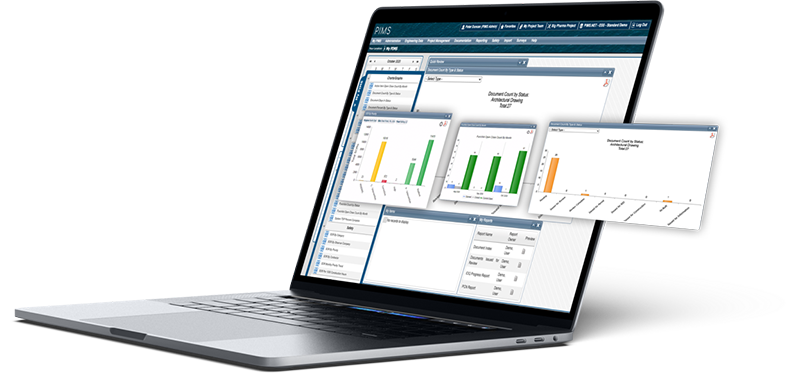
- What it includes: Project dashboards with configurable widgets covering document progress, deliverable status, completion record progress, punchlist metrics, and package readiness. System Activity Tracker with milestone tracking and commissioning progress visibility. Custom report builder with on-demand filtering, template selection, and scheduled export. KPI tracking and data export in standard formats.
- Why it matters: Project leadership and owner organizations need visibility into handover readiness — not just schedule adherence. PIMS reporting is designed specifically for that question: is this project ready to hand over, and what specifically stands between here and there?
Contact us
Let's Get Started
Our PIMSHQ software combines the best of project, program and knowledge management into a single, collaborative workspace providing real-time monitoring and seamless data dissemination.
Request Demo